
Without any grace period for implementation, investigation results, or opportunity for prior comment by H-1B employers in the State of Texas, Governor Abbott issued a letter on January 27, 2026, addressed to all state agency heads stating that, “The economy of Texas should work for the benefit of Texas workers and Texas employers.” The letter proceeds to direct all state agencies with a gubernatorially appointed head and public institutions of higher education to immediately freeze the filing of new H-1B non-immigrant visa petitions, as outlined.
Governor Abbott asserts in his letter that, in his view, some employers have misused the federal H-1B program by not making sufficient efforts to recruit qualified U.S. workers before seeking to use foreign labor. Labor market tests are usually included as a required step in seeking pathways to U.S. legal permanent residence (aka “green cards”), but the H-1B nonimmigrant category does not require a labor market test. Employers are required, however, to comply with and make certain attestations as to worksite conditions and wage requirements for the worksites stated in an H-1B Labor Condition Application (LCA). The governor also outlines that the state government must lead by example and ensure that employment opportunities, particularly “those funded by taxpayer dollars,” must be filled by “Texans” first.
The pause of the filing or initiation of any “new” H-1B petition applies to any state agency controlled by a gubernatorially appointed head or a public institution of higher education for a period lasting from January 27, 2026 to March 27, 2027, the end of the Texas Legislature’s 90th Regular Session. The potential initiation or filing of any H-1B petition (Form I-129) may be authorized by yet to be developed standards via written authorization of the Texas Workforce Commission (TWC).
The letter also requires all state agencies as defined above to provide the TWC with a report by March 27, 2026, comprised of an extensive list of information related to H-1B I-129 “new and renewal” petitions submitted by such agencies in 2025. The list provided is as follows:
a. How many new and renewal petitions the entity submitted for H-1B visas in 2025.
b. How many H-1B visa holders the entity currently sponsors.
c. The countries of origin of all H-1B visa holders the entity currently sponsors;
d. Job classifications and descriptions for each visa holder the entity currently sponsors;
e. The anticipated expiration date for each visa holder the entity currently sponsors; and
f. Documentation demonstrating efforts to provide qualified Texas candidates with a reasonable opportunity to apply for each position filled by an H-1B visa holder before a new petition was submitted for that position.
The letter also includes a prediction that these steps will provide time for the Texas legislature to “establish statutory guardrails for future employment practices regarding federal visa holders in state government.” These steps evidence an effort to establish state-level guidelines regarding employment practices affecting federal visa holders, which create conflicts with federal immigration and employment law.
Since this announcement, information has been provided to media outlets that Texas A&M University has allegedly spent more than $3.25 million on H-1B visas between January 2020 to November 2025.[1] In addition, Attorney General Paxton announced a “sweeping” investigation into abuse of the H-1B program by issuing Civil Investigative Demands (CIDs)[2] to three North Texas companies referencing the use of “ghost offices”. The example of such a ghost office was described as a business using a single-family home as its office address and on its website, it listed an empty, unfinished business as its worksite location.
Then, on January 31, 2026, Texas Senator Ted Cruz was quoted as saying that he “can’t imagine any reason why Dallas ISD should need any H-1Bs,” after the publication of records noting that the Dallas Independent School District spent roughly $2.5 million on H-1B visa legal services from 2020 to late September 2025. Governor Abbott’s pause, however, does not apply to K-12 school districts based on the letter itself.[3]
Federal Law
The State of Texas has been in the forefront of several challenges to the line between federal and state control in the area of immigration. For example, SB 4, passed in 2023 by the Texas legislature, is currently under consideration by the Fifth Circuit regarding the creation of a state law making it a crime to cross into Texas illegally. SB 4 also creates a robust state deportation system regarding this new law, which creates an aggressive game of chicken with federal preemption principles in the area of immigration (an area tied directly with national foreign policy).
While Governor Abbott’s H-1B pause is not legislative, it creates multiple issues of potential state requirements contradicting existing federal law requirements.
Who is Protected by Federal Law?
Federal law does not allow employers to engage in citizenship or national origin discrimination, unfair documentary practices during the employment eligibility verification process, or retaliation or intimidation for filing charges with or cooperating with an investigation of the Immigrant and Employee Rights (IER) section of the Civil Rights Division (CRD) of the U.S. Department of Justice (DOJ).[4] Those individuals who are considered work-authorized and protected from national origin discrimination are: U.S. citizens (USCs), legal permanent residents (LPRs), and foreign nationals authorized to work in the U.S., including refugees and asylees.[5] Title VII of the Civil Rights Act of 1964 protects employees or applicants from discrimination based on their national origin, including Americans.[6]
Title VII prohibits discriminatory job advertisements such as those expressing an employer’s preference or requirement to hire those with a particular status (e.g. “Only U.S. Citizens,” “Must present U.S. birth certificate, “H-1B only,” or “H-1B preferred”).[7] Citizenship status discrimination occurs when an employer refuses to recruit, refer, or hire or fire someone, because of their citizenship or immigration status.[8] An employer may hire only U.S. citizens based only on a legal justification, which is rare (i.e., law, regulation, executive order, or government contract).[9]
Employers are required to determine the work eligibility of new hires using the Form I-9 within three business days of the date of hire.[10] Texas has not imposed E-Verify upon private employers to reduce their potential exposure to fraudulent claims by new hires to legal work eligibility. In 2025, SB 324 and its companion HB 310 failed to become law in Texas, which would have mandated private employers to participate in E-Verify.[11] Some speculated that the legislators recognized the reliance by employers in Texas on an estimated 1.3 million Texas workers, more than 8% of the state’s work force, who are not in Texas legally and thus are ineligible to work under immigration law.[12]
Previously, in 2015 (SB 374), Texas state agencies, including higher education institutions, were required to use E-Verify. In 2014, Governor Perry issued an Executive Order (RP-80) requiring all agencies under the direction of the Governor to require the use of E-Verify as a condition of all state contracts for services.[13]
It is relevant to remember that the two pre-hire questions that have been accepted by the DOJ for use by employers in their recruitment efforts include:[14]
- Are you legally authorized to work in the United States? Yes ___ No ___
- Will you now or in the future require sponsorship for employment visa status (e.g., H-1B visa status)? Yes __No ___
While employers are not mandated by federal law to sponsor H-1B nonimmigrants, these questions do not facilitate any way to identify a Texan as an employment applicant.
So, can affected Texas State Agencies and Institutions of Higher Education Employers Legally Protect “Texans” first in their hiring practices?
No. Of course, how is the Governor defining a “Texan”?
- Is a Texan a Texan by birth or residence? Must the Texan’s parents be lawfully present in Texas at the time of their birth?
- What about Texas employers hiring employees who perform services outside of Texas?
- What if an asylee legally entitled to work in the U.S. is living in Texas? Are they considered a Texas hire?
- Are U.S. citizens considered as Texans if they reside outside of the U.S.?
- How are employers supposed to apply any state restrictions to hire workers and comply with federal labor and employment laws to avoid discrimination allegations under federal law?
- What pre-hire questions could employers use to hire “Texans first”?
- When will the TWC issue guidance to those affected employers by this H-1B pause?
H-1B Process
Some of the articles regarding the H-1B process criticize a lack of transparency regarding the H-1B nonimmigrant program or appear to imply that it allows U.S. workers to be preferred. It is important to know what this federal program is and how it is regulated as a starting point for any judgments. The H-1B category requires approvals/certifications by both the U.S. Department of Labor and U.S. Citizenship and Immigration Services (USCIS) to start in addition to a visa application abroad at a U.S. consular post staffed by foreign service officers of the U.S. Department of State (DOS).
The H-1B nonimmigrant category is available for “specialty occupations,” which include occupations that require a theoretical and practical application of a body of highly specialized knowledge in fields of human endeavor that require the attainment of a bachelor’s degree or higher in a specific specialty or its equivalent as a minimum for entry into the occupation.[15] Employers may establish the standard for the specialty occupation if the baccalaureate or higher degree is normally the minimum requirement for entry into the position offered, if the degree requirement is common for the industry, if the employer historically has required the degree or its equivalent for the position, or if the nature of the job’s duties are so specialized and complex that the knowledge required to do the duties of the job is usually associated with the attainment of a baccalaureate or higher degree.[16]
Due to prior enforcement and oversight concerns related to the H-1B nonimmigrant program, it is one of the most highly regulated of any nonimmigrant visa category. [17] The relevant DOL regulations are at 20 CFR §655.715 and 8 CFR §214.2(h)(4). These regulations apply to Texas public institutions and agencies desiring to sponsor H-1B petitions. The chart below outlines the basic steps:[18]
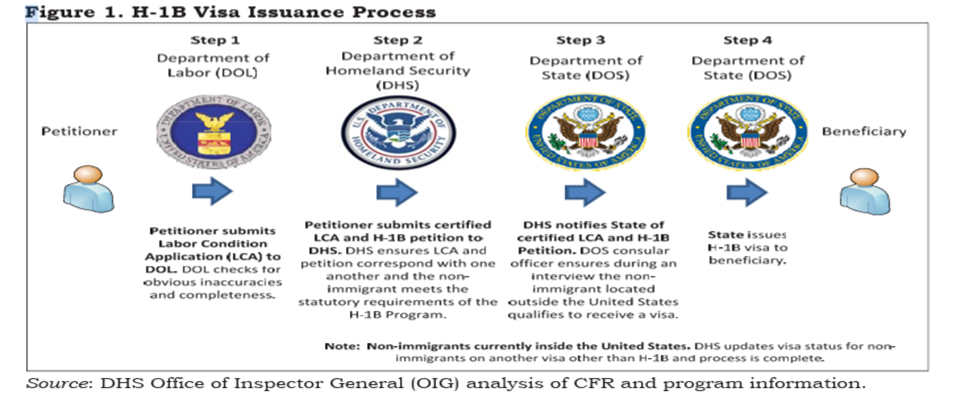
It is critical to note that the H-1B nonimmigrant visa process does not require a test of the U.S. labor market, which is a step normally required to seek U.S. permanent residence (aka green card). It does, however, require the labor condition application (“LCA”) certification from the DOL explained below in this article.
Filing Fees – The filing fees for the H-1B program for nonprofits and institutions of higher education reductions:
- I-129 Petition- $460.00 filing fee plus $500.00 Fraud Prevention and Detection Fee for an initial approval for H-1B status or approval to employ an H-1B nonimmigrant currently working for another employer.[19]
- I-907 Premium processing – $2,805.00 to get an answer from USCIS in fifteen business days versus the current processing time posted of approximately 5 to 7 months.
- H-1B Proclamation Payment – $100,000.00 if National Interest Exception (NIE) not approved by USCIS for those petitions submitted to USCIS after 12:01 am eastern daylight time on September 21, 2025 (Proclamation Effective Date). The Proclamation does not apply to any holders of previously issued H-1B visas or H-1B I-129 petitions submitted before the Proclamation Effective Date.[20]
Annual Lottery Competition – Unless exempt, employers compete every year for 65,000 visas with an additional 20,000 Master’s Cap visas under the advanced degree exemption in a lottery to become an H-1B sponsor for the job opportunity specified in their registration. In 2025, 470,342 eligible registrations were received while 343,981 eligible registrations were received in 2026.[21] Institutions of Higher Education and certain affiliated public schools qualify for exemption from the annual H-1B numeric cap and associated lottery.
Compliance with Labor Condition Application (LCA) requirement including posting notice, public access file (PAF), and certification of payment of required wage, which is the higher of the applicable prevailing wage or actual wage. Below is the attestation of employers filing the LCA (ETA-9035) with the DOL:
Employer Labor Condition Statements
! Important Note: In order for your application to be processed, you MUST read Section G of the Form ETA-9035CP – General
Instructions for the 9035 & 9035E under the heading “Employer Labor Condition Statements” and agree to all four (4) labor condition statements summarized below:
(1) Wages: The employer shall pay nonimmigrant workers at least the prevailing wage or the employer’s actual wage, whichever is higher, and pay for non-productive time. The employer shall offer nonimmigrant workers benefits and eligibility for benefits provided as compensation for services on the same basis as the employer offers to U.S. workers. The employer shall not make deductions to recoup a business expense(s) of the employer including attorney fees and other costs connected to the performance of H-1B, H-1B1, or E-3 program functions which are required to be performed by the employer. This includes expenses related to the preparation and filing of this LCA and related visa petition information. 20 CFR 655.731;
(2) Working Conditions: The employer shall provide working conditions for nonimmigrants which will not adversely affect the working conditions of workers similarly employed. The employer’s obligation regarding working conditions shall extend for the duration of the validity period of the certified LCA or the period during which the worker(s) working pursuant to this LCA is employed by the employer, whichever is longer. 20 CFR 655.732;
(3) Strike, Lockout, or Work Stoppage: At the time of filing this LCA, the employer is not involved in a strike, lockout, or work stoppage in the course of a labor dispute in the occupational classification in the area(s) of intended employment. The employer will notify the Department of Labor within 3 days of the occurrence of a strike or lockout in the occupation, and in that event the LCA will not be used to support a petition filing with the U.S. Citizenship and Immigration Services (USCIS) until the DOL Employment and Training Administration (ETA) determines that the strike or lockout has ended. 20 CFR 655.733; and
(4) Notice: Notice of the LCA filing was provided no more than 30 days before the filing of this LCA or will be provided on the day this LCA is filed to the bargaining representative in the occupation and area of intended employment, or if there is no bargaining representative, to workers in the occupation at the place(s) of employment either by electronic or physical posting. This notice was or will be posted for a total period of 10 days, except that if employees are provided individual direct notice by e-mail, notification need only be given once. A copy of the notice documentation will be maintained in the employer’s public access file. A copy of this LCA will be provided to each nonimmigrant worker employed pursuant to the LCA. The employer shall, no later than the date the worker(s) report to work at the place(s) of employment, provide a signed copy of the certified LCA to the worker(s) working pursuant to this LCA. 20 CFR 655.734.
I-129 Petition Approval from USCIS – requires compliance with the worksite, wage, and related conditions certified by the DOL in the LCA.[22] In addition, the regulations require additional posting notices to be filed with the DOL and amendments with USCIS regarding certain changes in worksite locations and/or job duties.
H-1B Data Transparency
Data related to the H-1B program is publicly available via the:
- H-1B Employer Data Hub at https://www.uscis.gov/tools/reports-and-studies/h-1b-employer-data-hub ;
- H-1B Labor Condition Application (LCA) Form ETA-9035 Disclosure Data – https://www.dol.gov/agencies/eta/foreign-labor/performance ;
- DOL Debarment Data of employers debarred or disqualified by the Wage and Hour Division (WHD) of the Office of Foreign Labor Certification (OFLC) within the Employment and Training Administration (ETA) under the H-1B program https://www.dol.gov/agencies/whd/immigration/h1b/debarment; and
- H-1B nonimmigrant visas issued by the U.S. Department of State (DOS) https://travel.state.gov/content/travel/en/legal/visa-law0/visa-statistics.html .
For Fiscal Year 2025, the top six users of the H-1B category providing educational services in the State of Texas were:
- Dallas Independent School District – 230
- UT Southwestern Medical Center – 220
- Texas A & M University – 210
- The University of Texas M.D. Anderson Cancer Center – 166
- The University of Texas at Austin – 165
- Baylor College of Medicine – 147
(These totals will be tied to a federal taxpayer identification number.)
It is important to remember that International Medical Graduates (IMG) often enter the U.S. for their residency training using a J-1 nonimmigrant visa. In order for them to transition to work in the H-1B category in the U.S.; they apply for a waiver of the two-year foreign residence requirement under §212(e) of the Immigration and Nationality Act, as amended. These waivers require three years of service in Health Professional Shortage Areas (HPSAs) or Medically Underserved Areas (MUAs). Those approved for such waivers are exempt from the H-1B numeric cap. For example, the Texas Department State Health and Human Services (TDSHS) administers the state’s Conrad 30 program every year to fill underserved area physician slots for foreign medical graduates. Experts have expressed concern about the impact of the H-1B pause on research institutions. John Soriano, assistant professor of economics at the University of Dallas, noted:
“This just totally screwed hiring at the cutting-edge research institutions in Texas, right in the middle of hiring season for new PhDs, the main users of H-1B,” said John Soriano, assistant professor of economics at the University of Dallas. “UT and A&M systems are world-class research centres, and this move hurts them. Online groypers first, Texas second.”
Healthcare professionals have also weighed in on potential implications. Krutika Kuppalli, global health expert and infectious disease physician, stated:
“Freezing new H-1B visas in Texas is short-sighted. We already face serious healthcare workforce shortages and struggle to meet patient demand. Public universities and health systems rely on H-1Bs to recruit physicians, nurses, scientists, and researchers. This will worsen staffing gaps, slow research, and harm patients, especially in underserved communities. This does not protect Texans. It weakens Texas healthcare.”[23]
In another article on this topic, the author noted that, “Healthcare workforce experts report that internationally trained physicians make up nearly 25% of doctors practicing in U.S. hospitals. Many serve in high-demand specialties such as internal medicine, oncology, emergency care, and anesthesiology, particularly in regions facing physician shortages.”[24]
Public K-12 schools have experienced hiring shortages for years, which has resulted in reliance on internationally trained educators in certain regions. Consider the 2020 report published by the Economic Policy Institute describing the teacher shortage in the U.S., particularly at high-poverty school locations.[25] The 2025 Fact Sheet published by the Learning Policy Institute (LPI) notes that, “interest in teaching among high school and college students is at the lowest level it has been in decades.” In addition, according to June 2025 analyses, at a minimum 411,549 positions were unfilled or filled by teachers not fully certified for their assignments, “representing about 1 in 8 of all teaching positions nationally.”[26] The Texas Tribune reported in 2022 that Texas ranked as one of the worst states for teacher retirement and that Texas, while producing teachers, was losing them at a high rate.[27]
Shouldn’t the State of Texas try to prevent fraud in the state related to the federal H-1B program?
The State of Texas can certainly report (and should) alleged violations of federal regulations and laws to strengthen the program’s legitimacy and legal compliance. It is important to remember that the H-1B program does not prohibit an employer from hiring telecommuters to work for a company whose home “office” might be a garage, for example. While some businesses may list unconventional worksite addresses, historical examples show that startups such as Microsoft and Dell initially operated from small or home-based offices.[28] What is critical, however, is that any H-1B employer be truthful and accurate in representations made to acquire an H-1B visa.
The H-1B program is already subject to compliance oversight by the DOL and USCIS.
USCIS uses the Fraud Detection and National Security (FDNS) Directorate’s Administrative Site Visit and Verification Program (ASVVP) to verify representations made in I-129 petitions using random site visits. USCIS also employs a Targeted Site Visit and Verification Program (TSVVP) to verify petition facts using a data-mining approach.[29]
In addition, the DOL recently implemented in September of 2025 “Project Firewall” to monitor and investigate the H-1B visa process. The initiative’s goal is to safeguard the rights, wages, and job opportunities of highly skilled American workers by “ensuring employers prioritize qualified Americans when hiring workers and holding employers accountable if they abuse the H-1B visa process.”[30]
Assuming that the TWC will issue guidance as to the Governor’s H-1B pause shortly, how do employers proceed?
Hopefully, the TWC will consider the information required as to labor protections by the LCA in the H-1B process, legitimate labor shortages, as well as the complexity of the applicable federal requirements regarding the H-1B program.
The State of Texas could take a different approach by working with the federal government to support potential actions by the administration to allocate additional H-1B nonimmigrant numbers to those Texas employers attempting to address critical labor shortages, such as in healthcare and education in addition to compliance cooperation.
Related Services:
About the Author:

Kathleen Campbell Walker is a Member of Dickinson Wright and Chair of the firm’s Immigration Practice Group, based in the El Paso and Denver offices. She is board certified in Immigration and Nationality Law by the Texas Board of Legal Specialization. A former national president and general counsel of the American Immigration Lawyers Association (AILA), she received the AILA Founder’s Award (now the Robert E. Juceam Award) in 2014, recognizing the individual or entity with the most significant impact on immigration law or policy during the preceding period. She has also testified multiple times before Congress on immigration and border security matters. She can be reached at KWalker@dickinsonwright.com.
[1]Seehttps://dallasexpress.com/education/abbott-demands-texas-am-disclose-h-1b-worker-info-amid-transparency-concerns/ .
[2] See https://x.com/KenPaxtonTX/status/2016663813513212173 .
[3]See https://dallasexpress.com/education/ted-cruz-questions-dallas-isds-use-of-h-1b-visas-after-2-5m-spending-revealed/ .
[4]See INA §1324(b), 42 USC §2000e-2, and 28 CFR Part 44 https://www.justice.gov/crt/immigrant-and-employee-rights-section .
[5]See Handbook for Employers M-274 | USCIS https://www.uscis.gov/book/export/html/59502.
[6]Seehttps://www.eeoc.gov/sites/default/files/202511/DISCRIMINATION_AGAINST_AMERICAN_WORKERS_IS_AGAINST_THE_LAW_508final.pdf .
[7]Id and https://www.justice.gov/crt/media/961626/dl .
[8]See Employer Fact Sheet Information for Employers about Citizenship Status Discrimination, published by the U.S. DOJ, CRD https://www.justice.gov/crt/media/961626/dl .
[9] See https://www.justice.gov/crt/best-practices-recruiting-and-hiring-workers .
[10]Seehttps://www.uscis.gov/i-9-central/form-i-9-acceptable-documentsandhttps://www.uscis.gov/i-9-central/form-i-9-resources/handbook-for-employers-m-274/10-why-employers-must-verify-employment-authorization-and-identity-of-new-employees
[11] See https://capitol.texas.gov/BillLookup/Actions.aspx?LegSess=89R&Bill=SB324 .
[12] See Kriel, Lomi, “Texas won’t force private companies to use E-Verify to check workers’ immigration status, despite leaders’ tough talk,” published in the Texas Tribune (June 5, 2025) https://www.texastribune.org/2025/06/05/texas-e-verify-requirements-immigration/ .
[13] See https://content.govdelivery.com/accounts/TXCOMPT/bulletins/e22864 .
[14] See https://www.justice.gov/media/1248166/dl?inline .
[15] See 8 CFR §214.2(h)(4)(ii).
[16] Id.
[17] See Office of the Inspector General of the U.S. Department of Homeland Security (DHS) Report entitled, “USCIS Needs a Better Approach to Verify H-1B Visa Participants, “ OIG-18-03 (October 20, 2017) https://www.oig.dhs.gov/sites/default/files/assets/2017/OIG-18-03-Oct17.pdf . Since this article, USCIS as expanded the use of Fraud Detection and National Security Directorate (FDNS) to conduct on site audits and reviews of H-1B program compliance. https://www.uscis.gov/scams-fraud-and-misconduct/report-fraud/combating-fraud-and-abuse-in-the-h-1b-visa-program and https://www.dhs.gov/publication/dhsuscispia-013-01-fraud-detection-and-national-security-directorate
[18] Id.
[19] See https://www.uscis.gov/forms/all-forms/h-and-l-filing-fees-for-form-i-129-petition-for-a-nonimmigrant-worker .
[20]See https://www.uscis.gov/newsroom/alerts/h-1b-faq and https://travel.state.gov/content/travel/en/News/visas-news/restriction-on-entry-of-certain-nonimmigrant-workers.html .
[21]See https://www.uscis.gov/working-in-the-united-states/temporary-workers/h-1b-specialty-occupations/h-1b-electronic-registration-process .
[22] See https://www.uscis.gov/i-129 .
[23] See Singh, Surbhi Gloria, “H-1B hiring pause will cost U.S. top doctors, and specialists, experts warn,” Business Standard (Jan. 30, 2026) https://www.business-standard.com/immigration/h-1b-hiring-pause-will-cost-us-top-doctors-and-specialists-experts-warn-126013000703_1.html and Sumbul MBBS, MD, “Texas H-1B Hiring Freeze Sparks Fears Over Doctor Shortages, Oncology Care, and Hospital Staffing Stability,”
[24] Id. “In a statement issued last year, the American Hospital Association highlighted the significant contribution of internationally trained healthcare professionals, particularly in rural and underserved regions. The association noted that nearly 26% of clinicians working in U.S. hospitals are non-citizen immigrants, many of whom join the healthcare workforce through visa programs such as the H-1B.”
[25] See Garcia, Emma and Weiss, Elaine, “A policy agenda to address the teacher shortage in U.S. public schools, The sixth and final report in the ‘Perfect Storm in the Teacher Labor Market’ series,” published by the Economic Policy Institute (Oct. 15, 2020) https://www.epi.org/publication/a-policy-agenda-to-address-the-teacher-shortage-in-u-s-public-schools/ .
[26] See “An Overview of Teacher Shortages: 2025,” published by the Learning Policy Institute (July 2025) https://learningpolicyinstitute.org/media/4764/download?inline&file=Teacher_Shortages_Overview_2025_FACTSHEET.pdf .
[27] See Lopez, Brian, “It’s not just COVID-19: Why Texas faces a teacher shortage,” The Texas Tribune (July 25, 2022) https://www.texastribune.org/2022/07/25/texas-teacher-shortage/ and more recently the failure of the 89th Texas legislature to pass meaningful retirement legislation https://www.texasaft.org/policy/retirement/unpacking-the-89th-legislature-your-right-to-a-secure-retirement/ .
[28] See “12 billion dollar companies that started in Garages,” in CEO North America (Jan. 20, 2026) https://ceo-na.com/business/12-billion-dollar-companies-that-started-in-garages/ .
[29]See https://www.uscis.gov/about-us/organization/directorates-and-program-offices/fraud-detection-and-national-security-directorate/administrative-site-visit-and-verification-program .
[30] See https://www.dol.gov/newsroom/releases/osec/osec20250919 .